Sciesmic
Newton's 3 Laws of Motion - FREE Video Worksheet - Physical Science for 2026
Newton's 3 Laws of Motion - FREE Video Worksheet - Physical Science for 2026
Couldn't load pickup availability
Why does a soccer ball stop rolling on its own — but keep going if nothing slows it down? Why does it hurt more to kick a boulder than a tennis ball? The answers all come down to three simple rules that changed science forever: Newton's Laws of Motion.
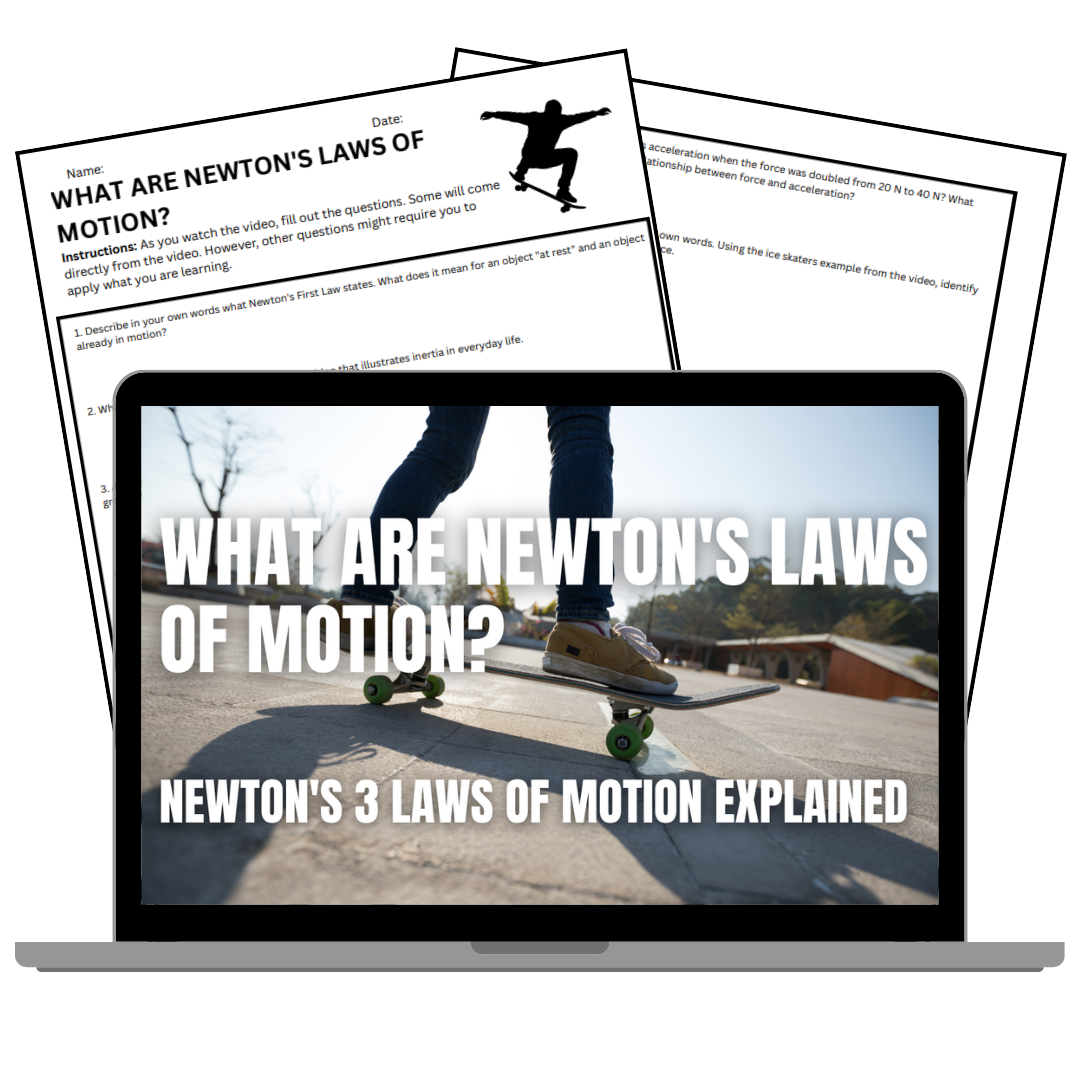
[Preview this free video here on YouTube]
NGSS Standards:
Perfect for: 6th, 7th, and 8th grade science students, 🎯 NGSS MS-PS2-1, MS-PS2-2, physical science units on forces and motion, and test prep.
TEKS Addressed:
🎯 Middle School Science: 6.7.C - The student is expected to identify simultaneous force pairs that are equal in magnitude and opposite in direction that result from the interactions between objects using Newton's Third Law of Motion.
🎯 7.7.D - The student is expected to analyze the effect of balanced and unbalanced forces on the state of motion of an object using Newton's First Law of Motion.
🎯 8.7.A - The student is expected to calculate and analyze how the acceleration of an object is dependent upon the net force acting on the object and the mass of the object using Newton's Second Law of Motion
🎯 8.7.B - The student is expected to investigate and describe how Newton's three laws of motion act simultaneously within systems such as in vehicle restraints, sports activities, amusement park rides, Earth's tectonic activities, and rocket launches.
⭐ What's Covered?:
✅ What Newton's First Law (Law of Inertia) really means
✅ Why objects in motion stay in motion — and objects at rest stay at rest
✅ How force, mass, and acceleration are connected (Newton's Second Law)
✅ How to use the formula F = ma to solve problems
✅ What Newton's Third Law means by "equal and opposite reactions"
✅ Real-world examples of all three laws in action
What will the students be doing?
● Students will be given either a printed or digital handout to record answers on.
● Either individually or as a class watch the video
● Then, they will use the video and their own knowledge to answer the questions.
● Use questions to spark discussions and apply information beyond the page!
Share