Sciesmic
Mixtures and Solutions: Homogeneous vs Heterogeneous - FREE Video Worksheet - Middle School Science for 2025 & 2026
Mixtures and Solutions: Homogeneous vs Heterogeneous - FREE Video Worksheet - Middle School Science for 2025 & 2026
Couldn't load pickup availability
Pour sugar into water and it disappears. Pour sand into water and it just sits there. Why? The answer lies in understanding mixtures, solutions, and solubility - how different substances combine (or don't!) and what determines whether something will dissolve. This is chemistry in action every time you make lemonade or stir salt into soup!
[Preview this free video here on YouTube]
Standards:
Perfect for 6th, 7th, and 8th grade students studying physical science and chemistry. This video aligns with 🎯NGSS standard MS-PS1-2, analyzing and interpreting data on the properties of substances before and after they interact to determine if a chemical reaction has occurred. It also addresses NGSS 5-PS1, Matter and Its Interactions.
TEKS Addressed:
🎯 Middle School Science: 6.6.B - The student is expected to investigate the physical properties of matter to distinguish between pure substances, homogeneous mixtures (solutions), and heterogeneous mixtures
⭐ What's Covered?:
✅ What mixtures are and how they differ from pure substances
✅ Heterogeneous mixtures: visibly different parts you can see
✅ Homogeneous mixtures (solutions): uniform throughout
✅ The dissolving process: how solutes break apart in solvents
✅ Solubility: what makes substances dissolve (or not)
✅ Factors affecting solubility: temperature, pressure, and particle size
✅ Real-world examples: cooking, medicine, ocean water, air we breathe
What will the students be doing?
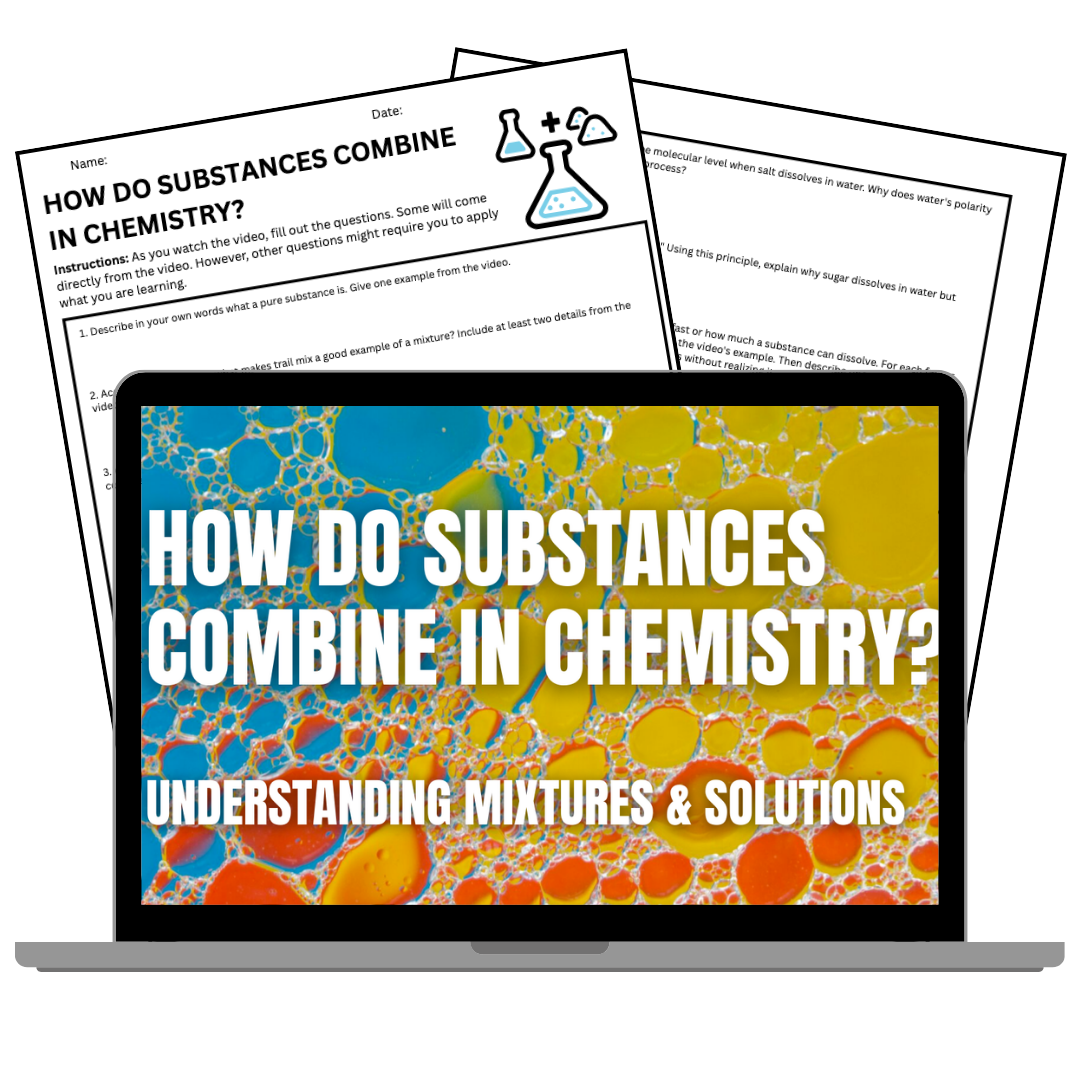
● Students will be given either a printed or digital handout to record answers on.
● Either individually or as a class watch the video
● Then, they will use the video and their own knowledge to answer the questions.
● Use questions to spark discussions and apply information beyond the page!
Share