Sciesmic
Renewable & Nonrenewable Energy - FREE Video Worksheet - Middle School Science for 2025 & 2026
Renewable & Nonrenewable Energy - FREE Video Worksheet - Middle School Science for 2025 & 2026
Couldn't load pickup availability
What makes up our solar system? How big is it? Why do planets orbit the Sun? Our solar system is a fascinating cosmic neighborhood containing the Sun, eight planets, dozens of moons, asteroids, comets, and more - all held together by gravity! Understanding our solar system helps us comprehend our place in the universe.
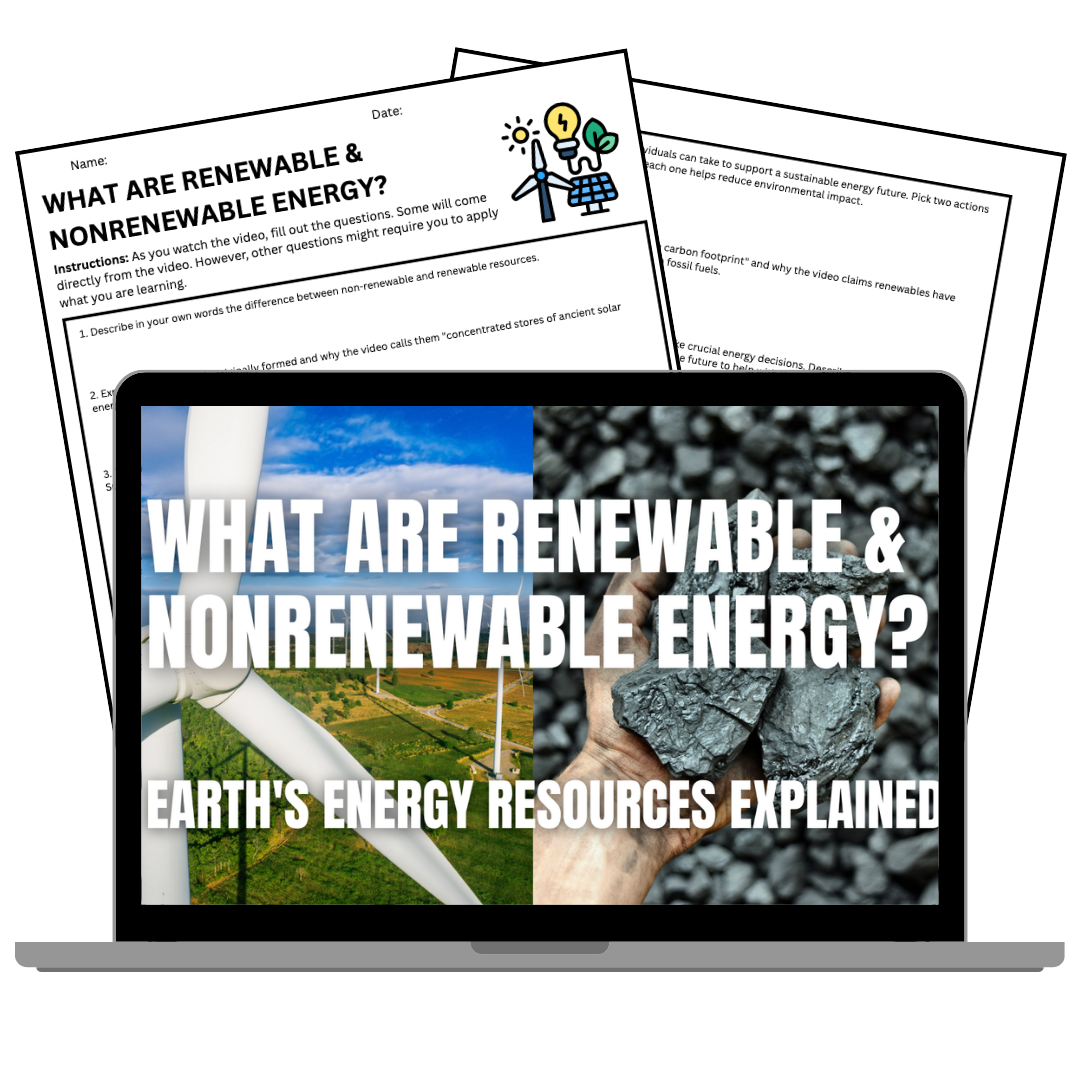
[Preview this free video here on YouTube]
Standards:
Perfect for 6th, 7th, and 8th grade students studying astronomy, space science, and Earth's place in the universe. This video aligns with 🎯NGSS standards MS-ESS3-3 (human impacts on Earth systems) and MS-ESS3-4 (design solutions for monitoring and minimizing human impacts).
TEKS Addressed:
🎯 Middle School Science: 6.11.B - The student is expected to explain how conservation, increased efficiency, and technology can help manage air, water, soil, and energy resources.
🎯 Integrated Physics & Chemistry: IPC.6.G - The student is expected to evaluate evidence from multiple sources to critique the advantages and disadvantages of various renewable and nonrenewable energy sources and their impact on society and the environment.
⭐ What's Covered?:
✅ The difference between renewable and nonrenewable resources
✅ Nonrenewable resources: fossil fuels (coal, oil, natural gas), nuclear energy
✅ Why fossil fuels take millions of years to form but we're using them rapidly
✅ Renewable resources: solar, wind, hydroelectric, geothermal, biomass
✅ Advantages and disadvantages of each energy source
✅ Environmental impacts: carbon emissions, climate change, pollution
✅ Making sustainable choices for our energy future
What will the students be doing?
● Students will be given either a printed or digital handout to record answers on.
● Either individually or as a class watch the video
● Then, they will use the video and their own knowledge to answer the questions.
● Use questions to spark discussions and apply information beyond the page!
Share