

Newton's Law of Gravitation Worksheet & Video | Middle School Science 2026
Are you teaching about Newton's Law of Gravitation in your science class? Then we have you covered! 🍎🌍
Ask your students what gravity is and you'll get a clean answer: "the force that pulls things down." Then ask them why astronauts float inside the International Space Station, and watch the whole thing fall apart. Almost every hand in the room says the same thing — there's no gravity up there. The ISS orbits about 250 miles above Earth, where gravity is still nearly as strong as it is in your classroom. Students can define the force perfectly and still get the most famous example of it completely backwards!
That gap isn't a vocabulary problem. It's a mechanism problem. Students learn gravity as a one-way arrow pointing at the floor, so anything that doesn't fall — the Moon, a satellite, an astronaut — must be somewhere gravity doesn't reach. They've memorized a direction instead of a relationship, and no amount of re-reading the definition fixes it, because the definition was never why they were confused.
We've created a FREE 7-minute video and worksheet that rebuilds gravity as a relationship between mass and distance — one that explains the falling apple, the orbiting Moon, and the formation of the entire solar system with the same idea. Here's how this resource builds authentic gravitational understanding.
[Download This Resource Now]
Your Students Know the Definition. They Still Think Space Has No Gravity. 🌌
Listen to how students talk about gravity and you'll hear the same handful of phrases: "gravity pulls things down," "gravity is 9.8," "there's zero gravity in space." Each one is a fragment of something true, wrapped around a misconception that never gets challenged.
The trouble is that every one of those phrases still works on a test. A student can label the arrow, plug in the number, and pass the question without ever knowing that gravity is mutual — that they pull on Earth exactly as hard as Earth pulls on them — or that it never turns off, anywhere, at any distance. It just gets weaker.
What closes the gap is seeing the two variables that actually control the force. Once students understand that gravity depends on mass and distance and nothing else, the confusing cases stop being exceptions. The astronaut isn't outside gravity's reach. The Moon isn't being held up by something. Both are doing the exact same thing a dropped pencil does — falling — and the mechanism finally does the explaining instead of the vocabulary.
7 Minutes to Understanding Gravity & The Law of Gravitation ⏱️🧠
Our video "What is Gravity? The Law of Gravitation Explained" builds true mechanistic understanding. Students discover:
✅ Gravity Is Universal (Not Just Earth's Job): Gravity is a force of attraction between any two objects that have mass. Students, their desks, the Earth, a distant star — if it has mass, it has gravity. The video uses the invisible-rope model: every object in the universe is roped to every other object, and the heavier and closer they are, the harder that rope pulls.
✅ Why You Don't Feel Pulled Toward Your Desk: The pull between a student and their desk is real, it's just incredibly tiny. Gravity only becomes noticeable when at least one object is massive — planet massive. Earth's enormous mass is what keeps every person, every ocean, and every cloud attached to its surface, and that reframes gravity as a matter of scale rather than a special property of the ground.
✅ Mass Controls the Strength: The more massive an object, the stronger its gravitational pull. The video anchors this in the Sun, which holds about 99.8% of all the mass in our entire solar system — which is exactly why the Sun, not Earth, sits at the center of everything's orbit.
✅ Distance and the Inverse Square Law: The farther apart two objects are, the weaker the pull — but not in a straight line. Double the distance and the gravitational force drops to one quarter of what it was. Students see that gravity weakens much faster than distance grows, which is the key to every "how far away does gravity stop?" question they've ever asked.
✅ Why Astronauts on the ISS Aren't Weightless: At about 250 miles up, astronauts are absolutely still in Earth's gravity. They float because they're in constant free fall around the planet — falling sideways, 24/7. This is the misconception-killer in the whole video, and it lands because students already have the mass-and-distance model in place when they get here.
✅ Newton's Law of Universal Gravitation: In 1687, Newton compressed all of it into F = G(m₁m₂)/d². The video breaks down each variable — F as the force between the objects, G as the gravitational constant that makes the math work, m₁ and m₂ as the two masses, d² as their distance squared — while making clear that the relationship matters more than the memorization: more mass = more gravity, more distance = less gravity.
✅ The Heavier-Falls-Faster Myth: In a vacuum with no air resistance, a bowling ball and a feather fall at exactly the same speed. Gravity accelerates all objects equally, regardless of mass. Galileo worked this out before Newton was born, and it still surprises students — which is precisely what makes it a great discussion moment.
✅ Why the Moon Doesn't Crash Into Us: The Moon is moving about 2,300 miles per hour sideways. Earth's gravity keeps pulling it inward, but that forward speed means it keeps "missing" Earth — and the balance of the two is a stable orbit. The video uses a ball swinging on a string: the string pulls inward, the speed carries it around, and cutting either one ends the orbit.
✅ How Gravity Built the Solar System: About 4.6 billion years ago there was only a drifting cloud of gas and dust. Something triggered a collapse, gravity took over, and the cloud spun faster as it shrank — the same way a figure skater speeds up by pulling in their arms. The center ignited into the Sun; the leftover disk clumped into rocks, then boulders, then planetesimals, then planets. Students end the video understanding that the ground under their feet exists because gravity spent billions of years pulling it together.
🎯 Standards Covered:
NGSS:
- MS-PS2-4 — Construct and present arguments using evidence to support the claim that gravitational interactions are attractive and depend on the masses of interacting objects.
- MS-ESS1-2 — Develop and use a model to describe the role of gravity in the motions within galaxies and the solar system.
TEKS:
- 6.7(A) — Identify and explain how forces act on objects, including gravity, friction, magnetism, applied forces, and normal forces, using real-world applications
- 7.9(B) — Describe how gravity governs motion within Earth's solar system
- 7.9(A) — Describe the physical properties, locations, and movements of the Sun, planets, moons, meteors, asteroids, comets, Kuiper belt, and Oort cloud
- 8.7(B) — Investigate and describe how Newton's three laws of motion act simultaneously within systems such as rocket launches
- PHYS.5.F - The student is expected to calculate the effect of forces on objects, including tension, friction, normal, gravity, centripetal, and applied force, using free body diagrams and the relationship between force and acceleration as represented by Newton's second law of motion.
Physics teacher Emily Hunt drops a student’s egg contraption from a school roof.
This is a great example of how to hook your students and leverage their curiosity. 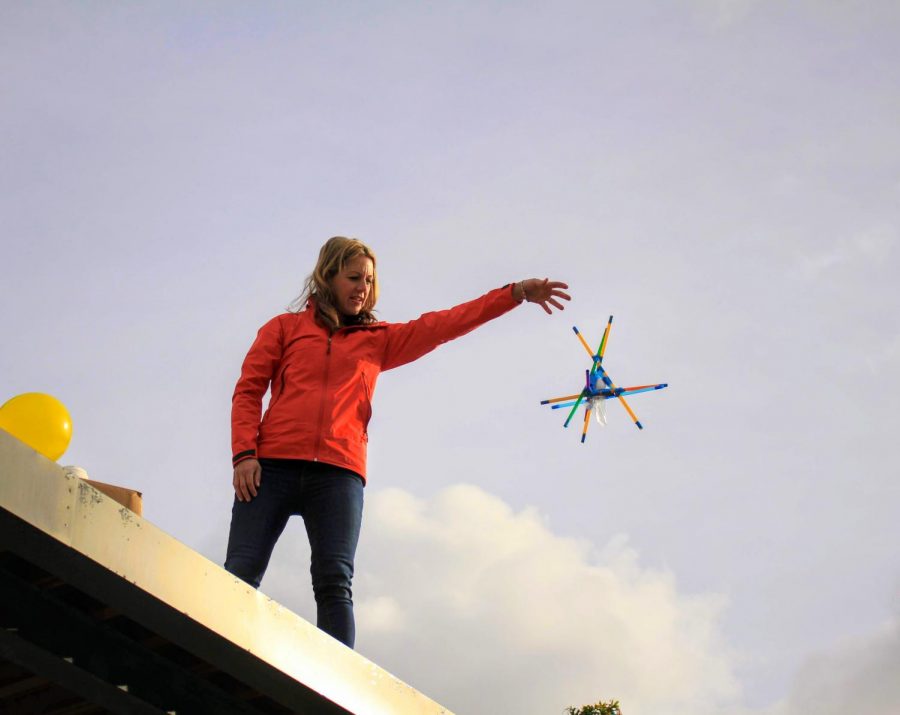
🧠 Extend with Comprehensive Learning Resources
Want deeper exploration? Our related resources provide multiple pathways!
⚓ Anchoring Phenomena Activities:
 .
. 
- Gravity and Gravitational Force — Students investigate real gravitational data to argue that attraction depends on mass and distance, not on which object is "bigger"
- Gravity and Orbital Motion — Students model why orbiting objects stay in orbit, connecting sideways velocity and gravitational pull to the free-fall explanation from the video
- Newton's Laws of Motion — Students extend the gravitation relationship into the broader force-and-motion framework Newton built it on
🥼 Lab Stations — Newton's Law of Universal Gravitation

Students rotate through hands-on stations that turn the formula into something they can manipulate. Stations explore:
- Mass vs. gravitational force
- Distance and the inverse square relationship
- Free fall and acceleration due to gravity
- Orbital motion modeling
- Applying F = G(m₁m₂)/d²
- Weight vs. mass on different planetary bodies
📖 Reading Articles for Gravity Understanding


-
The Mystery of Gravity (Everyday Physics) — Reinforces gravitational vocabulary and the mass-distance relationship in an accessible reading format, with supports that work well for ELL and struggling readers
- Isaac Newton | Major Figures of Science — Places the 1687 law in its historical context and shows students how one relationship reshaped all of physics
Implementation Strategy 🤔💭
Day 1: FREE Gravity & The Law of Gravitation video worksheet — Students build the mass-and-distance model and confront the "no gravity in space" misconception before it can harden into a testing error.
Days 2-3: Gravity and Gravitational Force + Gravity and Orbital Motion phenomena — Students argue from real data that gravitational attraction is mutual and distance-dependent, then model why orbits persist.
Days 4-5: Newton's Law of Universal Gravitation lab stations — Students manipulate mass and distance directly, turning the formula from something they copied into something they've tested.
Days 6-7: The Mystery of Gravity + Isaac Newton reading articles — Students consolidate vocabulary and place Newton's insight in the history of science, giving strong readers depth and developing readers a second pass at the core relationship.
This progression moves from video introduction → data-driven investigation → hands-on experimentation → reading for depth.
[Download FREE Video Worksheet]

Want to explore more resources such as the anchoring phenomena or lab station activities? All of these resources are included in our science libraries. Explore everything we have to offer with a FREE school or district pilot! This includes all of our standards-aligned middle and high school resources. Claim your free pilot now!
