Sciesmic
Comparative Anatomy: Reading the Evidence for Common Ancestry | Middle School Science
Comparative Anatomy: Reading the Evidence for Common Ancestry | Middle School Science
Couldn't load pickup availability
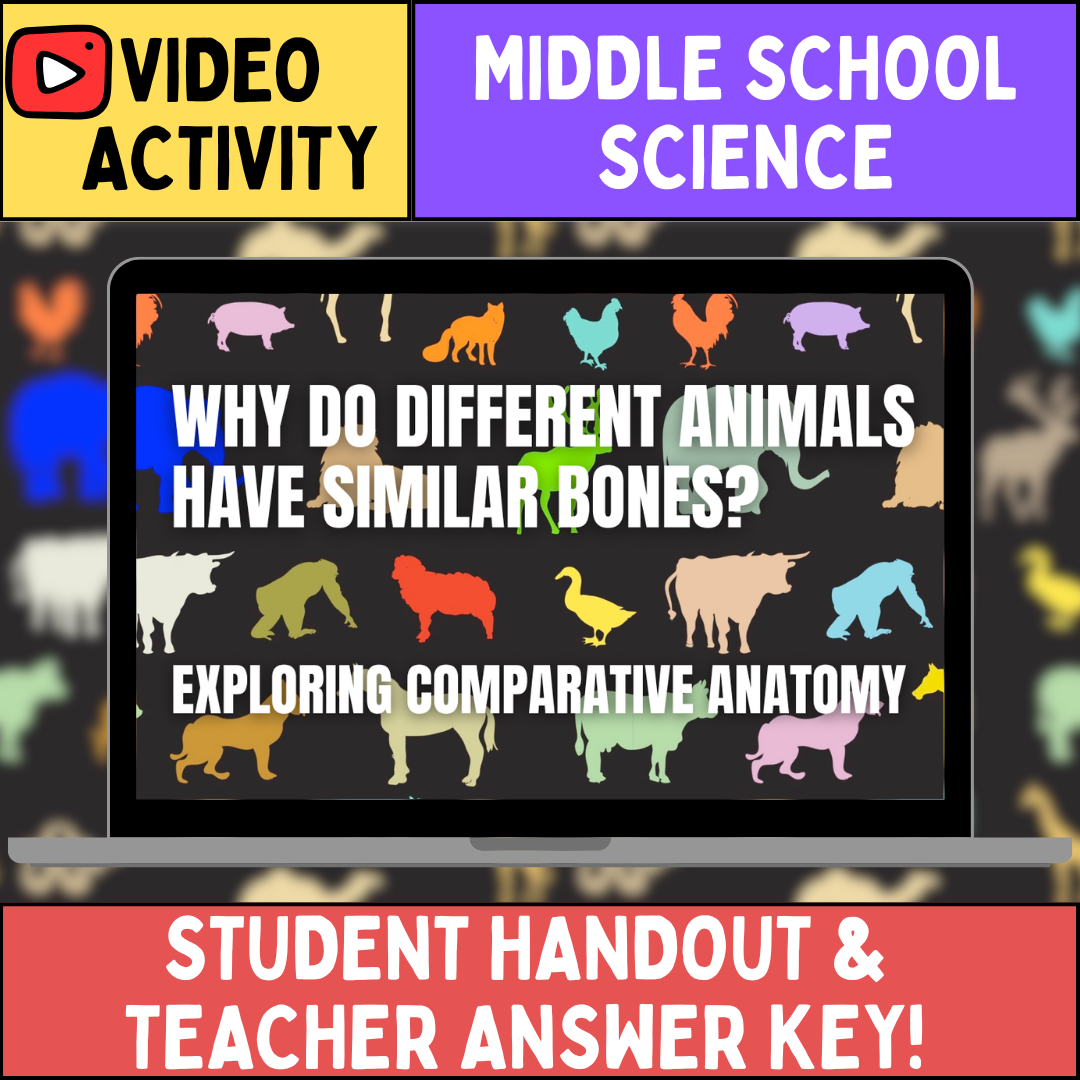
Why do your arm, a bat's wing, a whale's flipper, and a cat's leg all have the same bones arranged in the same order? How can studying body structures reveal which animals are related? Comparative anatomy provides powerful evidence for evolution by showing how similar structures suggest common ancestry!
Standards:
NGSS:
- MS-LS4-2
TEKS:
- 7.13.D, BIO.9.A
⭐ What's Covered?:
✅ What homologous structures are and what they reveal about evolution
✅ How to identify anatomical similarities despite different functions
✅ Why vestigial structures provide evidence for evolutionary change
✅ The difference between homologous and analogous structures
✅ How comparing fossils and modern organisms shows relationships
✅ Real examples: vertebrate limbs, whale ancestors, and human vestigial features
✅ How DNA evidence confirms anatomical relationships
What will the students be doing?
● Students will be given either a printed or digital handout to record answers on.
● Either individually or as a class watch the video
● Then, they will use the video and their own knowledge to answer the questions.
● Use questions to spark discussions and apply information beyond the page!
Share