

Beyond the 'Big Test': What the Texas SST Transition Means for Your Science Classroom
If you have spent any time in a Texas science classroom over the last decade, you know the specific, heavy silence of "The Big Test" day. It is that Tuesday in late Spring when the hallways are stripped of posters, the cafeteria is eerily quiet, and the stakes feel impossibly high.
For years, we have lived and breathed by that single snapshot, the STAAR test. We spend months building incredible, inquiry-based experiences, only to feel that crushing pressure to "cover everything" before that one high-stakes day. But if you have been following the news from Austin lately, you know that the landscape is shifting. The era of the "one and done" assessment is finally starting to sunset, making way for something that looks a lot more like real teaching: the Student Success Tool, or SST.
Let’s be honest with each other for a second. The transition from the traditional STAAR to the SST model under House Bill 8 isn't just another change in acronyms. It represents a fundamental shift in how the state views student progress and, more importantly, how we as educators are expected to track it. If you’re anything like me, your first reaction might be a mix of relief and a tiny bit of "here we go again" exhaustion. 🙄
We’ve been through a lot of changes in Texas education recently, but this one actually feels like it might be on our side for once. Instead of that frantic sprint to May, we are looking at a "triple-assessment" model that breaks the year into three checkpoints: Beginning-of-Year (BOY), Middle-of-Year (MOY), and End-of-Year (EOY).
Why the Shift is Happening Now
The thing is, the "autopsy" model of testing, where we get data months after the students have left our classrooms, has never really served us. By the time we find out a group struggled with the 8.7B TEKS (Earth, Moon, and Sun), they’re already halfway through their summer break, and we’re already looking at a whole new roster of faces. House Bill 8, passed back in 2025, was designed to fix that disconnect. The goal of the SST is to provide a more longitudinal view of student growth.

The 2026 school year is a massive turning point for us. We are currently in the thick of the transition year, with the full, state-wide rollout expected by the 2027-2028 school year. For those of us in the science lab, this means we have a unique window to rethink our pacing and our priorities. We aren't just teaching toward a finish line anymore; we’re teaching toward milestones. And while change is always a little messy, the prospect of having 48-hour reporting on these assessments is a genuine game-changer. Imagine knowing by Thursday exactly which concepts from your Monday lab didn't stick, rather than waiting until July.
Rebranding the Science Experience
One of the most notable changes for our middle school colleagues is the rebranding of the "8th Grade STAAR Science" assessment to "Middle School STAAR Science." This might seem like a small semantic tweak, but it’s actually a reflection of the reality we’ve always known: science isn't a siloed 8th-grade event. It’s a cumulative journey through the 6th, 7th, and 8th-grade TEKS. By rebranding the test, the state is acknowledging that student success in middle school science is a shared responsibility across the entire department. It’s about building a foundation in 6th grade that doesn't just "show up" in 8th grade but grows consistently over three years.

For high school teachers, specifically those in the Biology EOC trenches, the SST transition offers a similar breath of fresh air. The ability to utilize BOY and MOY data means we can identify those "bubble students" long before the spring fever hits. It allows us to pivot. If the data shows that your students are crushing the cellular processes but stumbling on genetics, you don't have to guess. You can adjust your phenomena-based lessons and lab rotations on the fly. This isn't about teaching to the test; it’s about using the test to inform the teaching.
Moving from Data Points to Lab Points
So, what does this actually look like in a busy science classroom? It means we have to stop treating data as a scary word and start treating it as a partner. When we have access to frequent, standards-aligned feedback through the SST, we can finally lean into the "investigative" part of our jobs. Instead of rushing through a chapter to stay on a rigid pacing calendar, we can use those MOY results to decide if we need an extra week of hands-on investigations or if we can move on to the next big concept.
This shift toward ongoing, standards-based growth is exactly why we built our resources the way we did. Whether you are using the Middle School Science Library or our High School Biology Library, the goal is to provide classroom-tested labs and phenomena-based articles that align perfectly with the TEKS. We want to help you bridge the gap between "what the test asks" and "what the students experience." When you have a library of resources that are already expertly aligned to the standards, you don't have to spend your weekends hunting for materials that match your SST data. You just grab the lab, prep the supplies, and watch the lightbulbs go off.

The Human Element of the Transition
We have to acknowledge the elephant in the room: any new state mandate feels like "one more thing" on an already overflowing plate. But I want to encourage you to see the SST as an amplifier of your effort, not a replacement for your expertise. You know your students better than any assessment ever will. You know that the quiet kid in the back row is a brilliant engineer even if they struggle with multiple-choice questions. You know that the student who failed their last quiz was actually just having a terrible week.
The SST doesn't replace that intuition; it supports it. It provides a common language for districts, campuses, and teachers to talk about what’s working. It’s a way to ensure that every student, regardless of their background, has a fair shot at mastering the science concepts that will shape their future. And as we move toward that full 2027-2028 rollout, we have the opportunity to lead this charge. We can show our students that science isn't about one big day of stress, it’s about a year-long journey of discovery.

Preparing for September and Beyond
As we wrap up summer and start journeying through the next year, the best thing we can do is stay informed and stay flexible. The TEA will be releasing more status reports and transition plans by February 2027, and we’ll be right here with you to break them down. In the meantime, don't be afraid to experiment with your data now. If your district offers optional BOY or MOY assessments this coming year, take them. Use them as a low-stakes way to see where your students are.
If you’re feeling overwhelmed by the idea of realigning your entire curriculum to this new model, remember that you don't have to do it alone. Sciesmic’s Texas EOC Review and our Biology EOC resources are designed to make this transition as seamless as possible. We are committed to keeping our materials updated as the SST evolves, so you can focus on what you do best: sparking curiosity in the next generation of scientists.
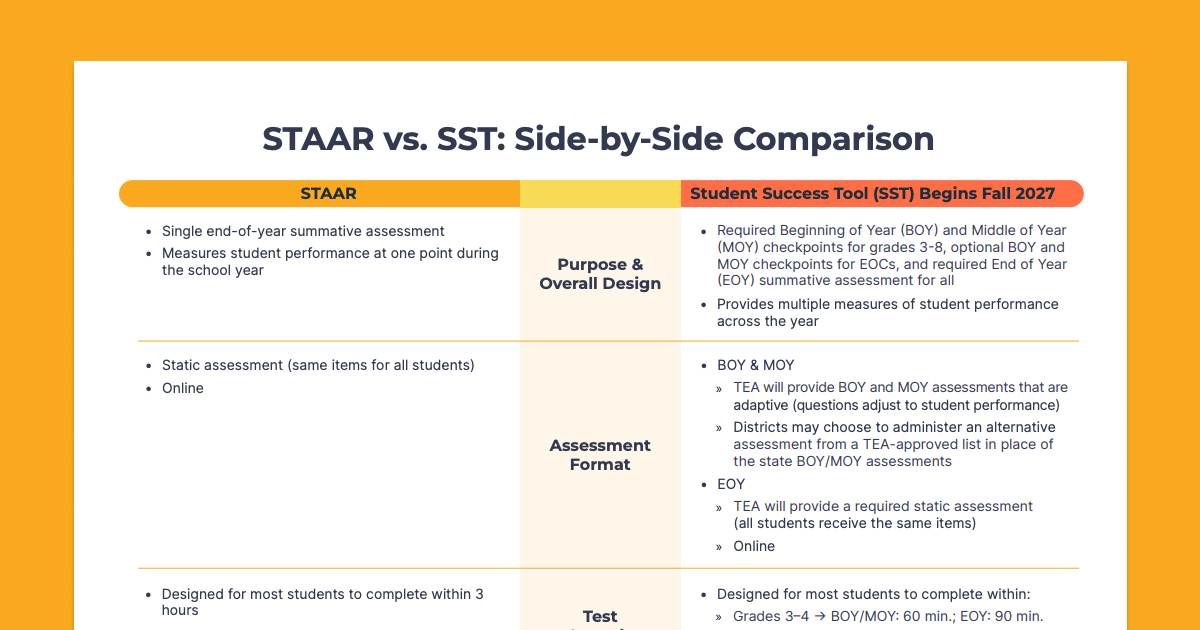 Explore this fantastic side-by-side of each assessment directly from ESC 13.
The transition from STAAR to SST is a challenge, yes. But it’s also an invitation. It’s an invitation to reclaim our classrooms from the shadow of "The Big Test" and put the focus back where it belongs: on the hands-on, messy, beautiful process of learning science. We’re in this together, and I truly believe that on the other side of this transition, we’re going to find a more sustainable, more effective way to teach.
Are you ready to join the revolution? Let’s make the 2026-2027 school year the one where we finally move beyond the test. Check out our sample content today and see how our TEKS-aligned resources can support your SST journey. Your future self: and your students( will thank you.)